
The Bloom
On Garry Winogrand, Akua Naru, and the strange movement by which a world appears.

It is Sunday afternoon.
Akua Naru is playing.
Rich, warm, sensuous, alive.
The room feels full.
On the table is Winogrand Color.
And there it is again, that strange thing photographs can do.
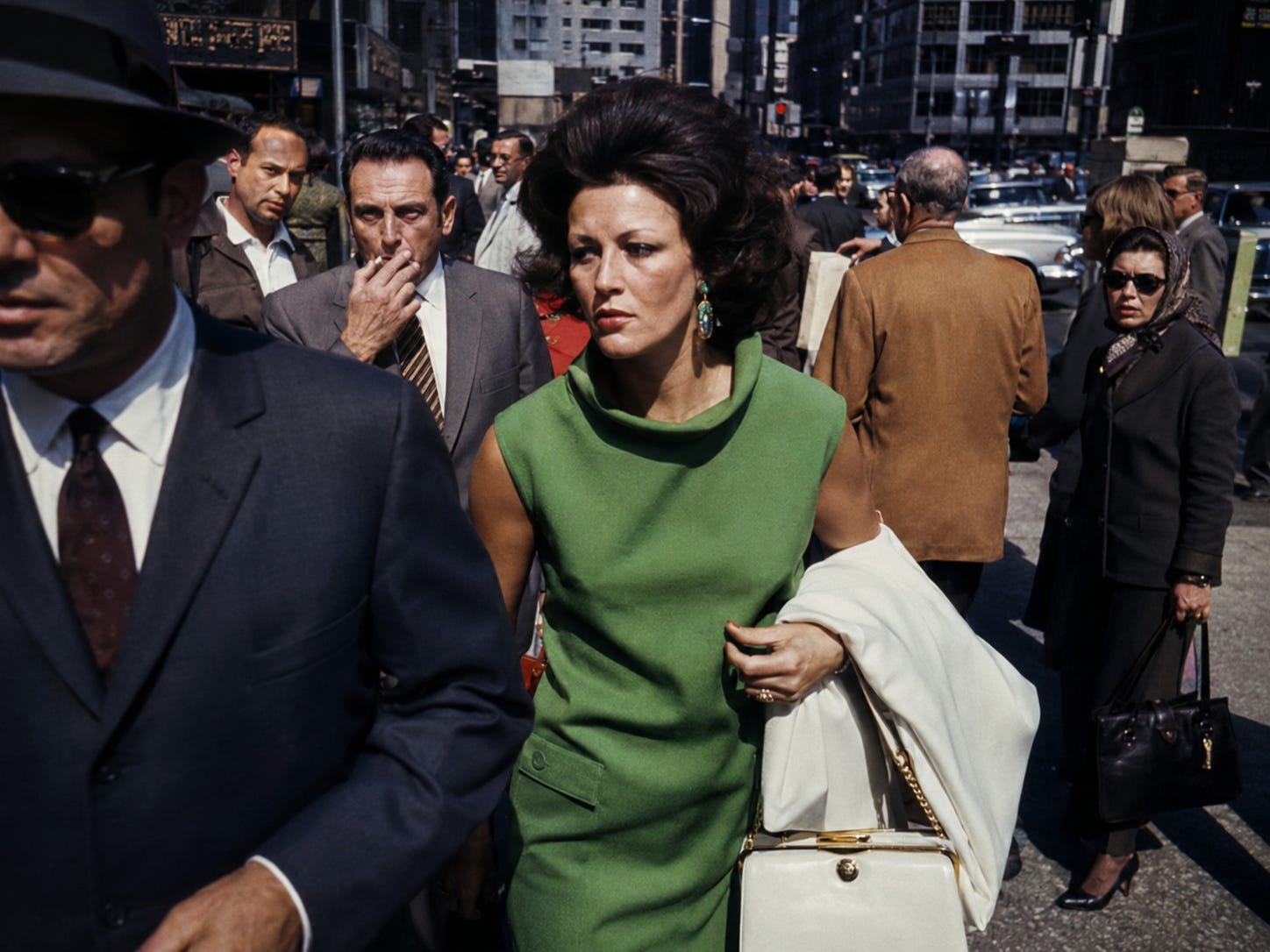
A face. A glance. A woman in a green dress. A man turning away. A sharp look from behind sunglasses. A street corner. A taxi. A coat.
And almost instantly, more appears.
Not just colour.
Not just shape.
Not just the brute fact of what is there on the page.
A whole world appears.
These people seem alive. They seem full of history. They seem to carry moods, intentions, disappointments, plans. You look and you feel it. You start imagining. Who were they? What had just happened? Where were they going? What happened next? The image blooms into life.
That blooming is beautiful.
It is not a mistake in the ordinary sense. It is not something to sneer at or strip away with a dry, superior attitude. It is one of the glories of being human. Music does it. Photographs do it. Language does it. A room does it. A face does it. The whole display is constantly flowering into meaning.
But if you look a little more closely, something very odd begins to show itself.
What is actually given?
In the photograph itself, what is there?
Colour.
Tone.
Shape.
Contrast.
Pattern.
Edge.
Presence.
That is what is given.
But the people as known, the felt sense of their inner lives, their stories, their reality as characters moving through a world, all of that is supplied.
Supplied instantly. Supplied beautifully. Supplied with astonishing intelligence. But supplied nonetheless.
The mind does not merely register. It composes. It maps. It interprets. It spins connection, continuity, depth, world.
And because it does this so fast, so gracefully, so intimately, the supplied world can feel as though it is simply there, plain as day, sitting in the image itself.
But it isn’t.
Zoom in.
Closer.
Closer still.
Where is the woman?
Where is the businessman?
Where is the lonely child, the flirtation, the errand, the private sorrow, the social world?
At a certain point there is only colour.
Not because the photograph has failed, but because the photograph has succeeded so completely in provoking the miracle. It gives enough, and the rest flowers.
That flowering is what interests me.
Because it is not confined to art.
This is how a world appears.
Not just in photographs. In life.
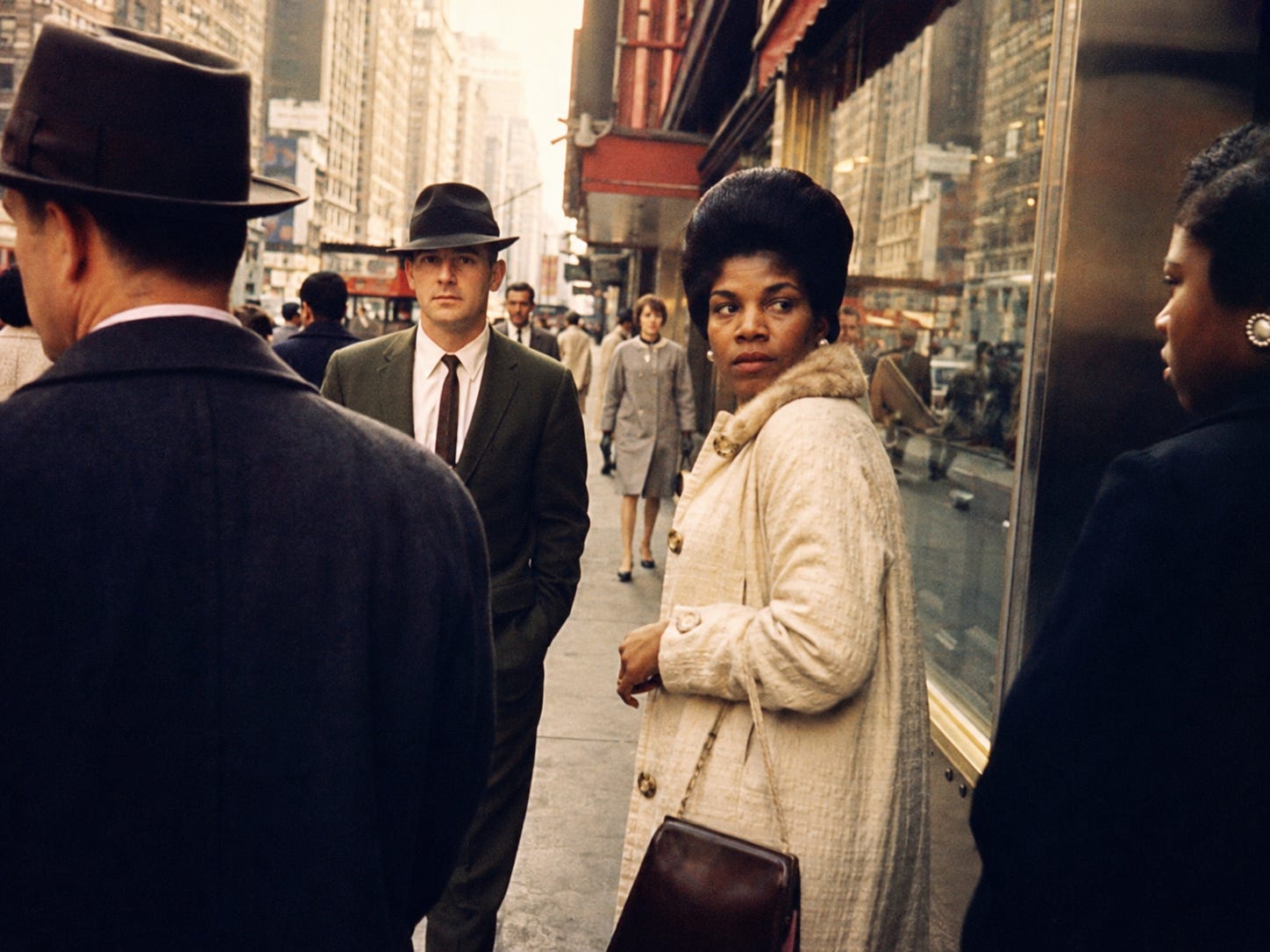
What is given, in immediate experience, is always far leaner than what is usually claimed. Colour is given. Sound is given. Sensation is given. Thought is given. Moods are given. Felt implication is given. But the finished world we habitually live in, with its fixed people, situations, meanings and conclusions, is built through an astonishing movement of supply.
That is where the spell loosens.
What is given.
What is supplied.
And most of the time they are fused.
So fused that we do not notice the join.
We take the bloom for the thing itself.
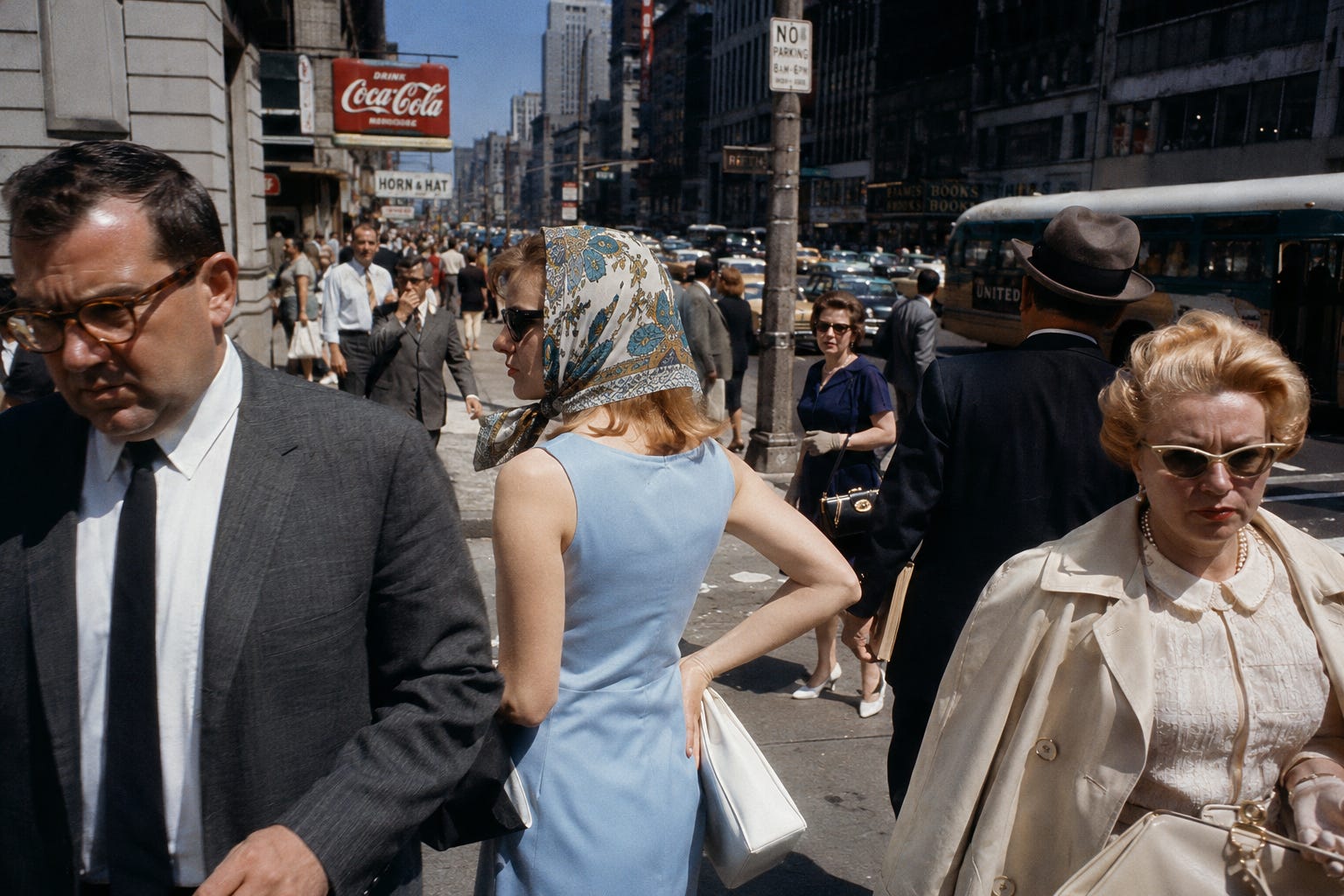
A photograph makes this easier to see because the supplied element becomes obvious once you look. You can feel the life in the image. You can feel the pull of story. You can feel the reality of the people. And yet, under inspection, none of that resolves in the way it first seemed to.
That does not make the bloom false in the cheap sense. It makes it revealing.
It shows the generative power of mind. It shows how a world is continuously conjured from what is immediately present. It shows how richness, significance and apparent solidity arrive. And it shows, too, how easily interpretation can masquerade as direct fact.
That matters.
Because suffering lives in that confusion.
Not in colour.
Not in sound.
Not in the bare given.
It lives in the supplied world when that supplied world is taken as simple fact. When the interpretation hardens. When the bloom becomes a prison.
Then the same power that makes art vivid makes life heavy.
But seen clearly, the whole thing becomes lighter. Stranger. More beautiful.
Then a photograph can be what it is.
A song can be what it is.
A Sunday afternoon can be what it is.
Not flat. Not reduced. Not deadening.
Quite the opposite.
More alive because nothing needs to be forced into a fixed conclusion.
The bloom still happens. Of course it does. It is part of the play. Part of the radiance. Part of the strange intelligence by which this display becomes a world.
But now it is seen.
And in that seeing there is a little more space.
A little less hypnosis.
A little more wonder.
A note on the inspirations
This piece began with Winogrand Color on the table and Akua Naru’s The Journey Aflame playing in the room.
One gives colour, gesture, street, faces, bodies, movement.
The other gives voice, rhythm, warmth, groove, language, breath.
Both are full of life.
And both, in their different ways, opened the same question:
What is actually given?
And what does the mind supply?
Want to explore this directly?
More focused writings and live inquiry sessions are available on Patreon:
https://members.thisradiantspace.com
For those interested, there are also a couple of places left on the workshop starting in June, where we’ll explore this directly in a live setting.
This was Amazing! Thank you Rob!